
Part 3 of 4: How one engine delivers transactional and analytical performance without picking a side.
VAST DataBase series: Part 1 — Why modern data architectures break | Part 2 — Inside the VAST Database engine | Part 3 (this post) | Part 4 — coming soon
Part 2 explained the architecture, meaning DASE and a single engine for tables, files, and streams. This post gets concrete about the oldest trade-off in databases: the one between fast writes and fast analytics. Understanding it is the key to seeing why the VAST DataBase can serve both transactional and analytical work on the same data, at a scale where most engines are forced to pick a side.
VAST DataBase series hub — full series index
Executive summary
The deepest trade-off in databases is physical. Data laid out by row is fast to write and to fetch one record at a time. Data laid out by column is fast to scan and add up, and it compresses far better. Row layout powers transactions, the day-to-day running of the business. Column layout powers analytics, the reporting and trend analysis. Because no classic layout wins at both, the industry runs two systems and copies data between them on a schedule, and that copy is the reason so many dashboards report on data that is hours or days old.
The VAST DataBase refuses that trade-off. It pairs a fast, consistent write path with a scan-optimized, highly compressed read path on a single shared pool of flash, and it guarantees ACID transactions (explained below) at very large scale. The payoff is not a tuned version of the old workflow. It is removing the copy between the transactional system and the analytical system altogether, which means real-time analytics on one trustworthy copy of the data.
Row versus columnar in ninety seconds
The single most important storage decision a database makes is the physical layout of data on media: row by row, or column by column. It sounds academic, but it decides almost everything about performance.

- Row stores keep all the fields of a record next to each other. To read or update one customer’s order, the engine touches one location, so writes and single-record lookups are very fast. This is why row stores power transactions.
- Columnar stores keep all the values of one field together. To average a million order amounts, the engine reads only the amount column and skips the rest, so scans and totals are very fast. Because a column holds similar values, it also compresses far better. This is why columnar stores power analytics.
| Feature | Row (Relational) | Columnar |
|---|---|---|
| Storage | By row | By column |
| Best for | Transactions (OLTP) | Analytics (OLAP) |
| Speed | Fast single-record read and write | Fast aggregations |
| Writes | Very fast | Slower |
| Reads (analytics) | Slower | Very fast |
| Compression | Lower | Higher |
Two workloads, one painful choice
Those two layouts map onto two kinds of work that most organizations run side by side:
- OLTP, online transaction processing, handles frequent, real-time transactions such as order entries, payments, and inventory updates. It needs fast, reliable single-record writes, which is the home turf of relational row stores.
- OLAP, online analytical processing, handles complex questions over huge datasets such as sales-trend reports, dashboards, and features for training models. It needs fast scans and totals, the home turf of columnar stores.

Because a single layout cannot be best at both, the usual answer is to run two systems and copy data from the transactional one into the analytical one on a schedule. That copy is the pipeline from Part 1, and it is the reason your dashboards report on data that is hours or days behind.
Most real-time analytics projects stall on the same rock. The freshest data lives in the transactional system, the analytics live in a separate analytical system, and the bridge between them is a fragile, lagging pipeline.
How the VAST DataBase refuses the trade-off
The VAST DataBase is engineered so the same data can serve transactional access and analytical queries without keeping two physical copies in two systems. Three design choices make that possible.
1. A write path tuned for fast, consistent ingest
Writes land quickly and durably into the shared all-flash pool from Part 2. Because storage is disaggregated and shared, an incoming write does not have to be routed to the one server that owns a shard, and it does not fight large analytical scans for a single disk. New and updated records become visible to queries right away, so there is no nightly load step standing between a transaction and the analytics that need it.
2. A query path tuned for wide, selective scans
On the read side, the engine behaves like a high-end analytical system. It reads only the columns a query needs (called projection), skips data that cannot match a filter (called predicate pushdown), and takes advantage of the strong compression that columnar layout allows. Analytical queries scan less physical data and move less of it across the network, which keeps large totals fast even as the data grows.
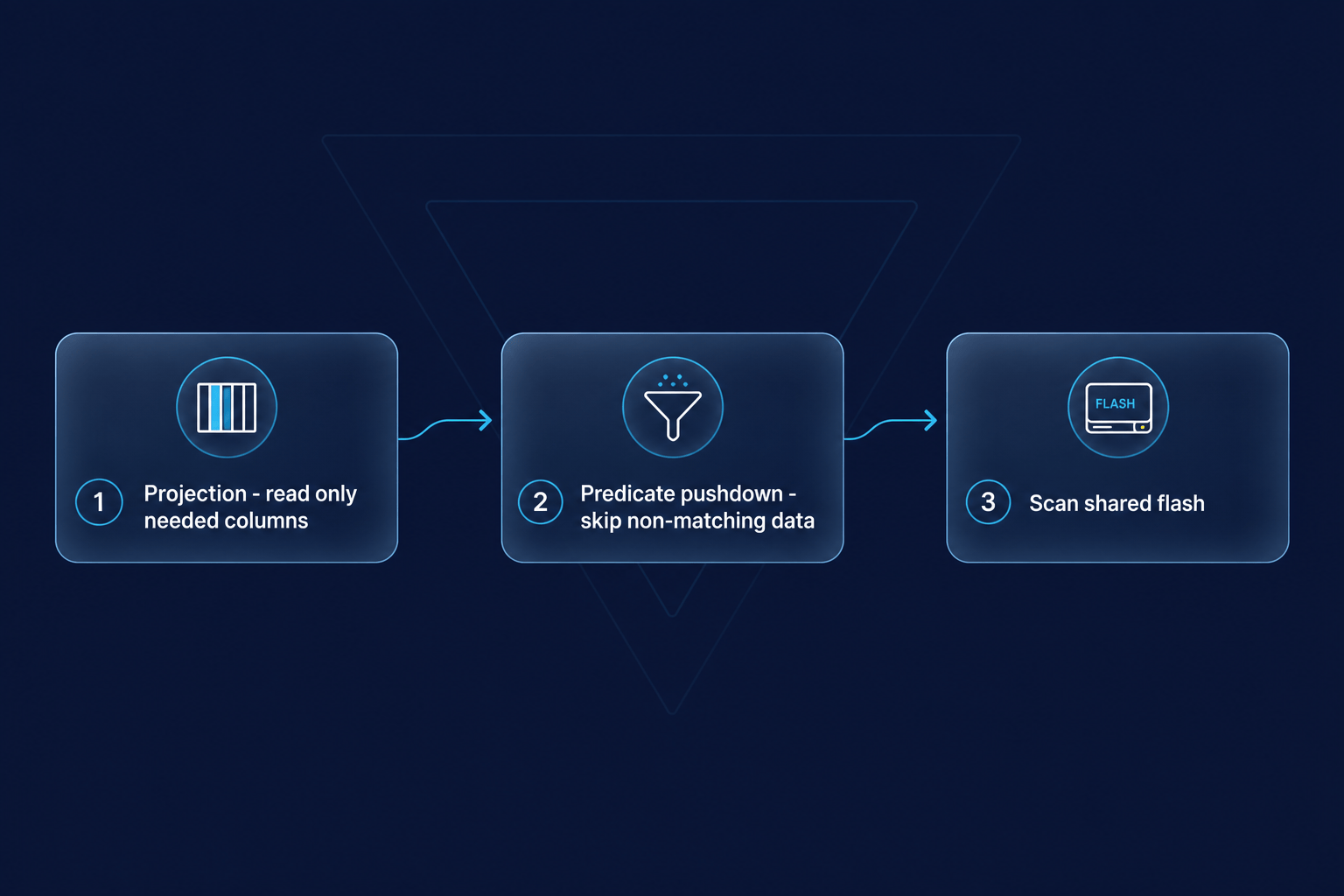
3. Flash-native efficiency at scale
All of this runs on a shared pool of flash, not a row store’s spinning disks or a lake’s distant object storage. Flash removes the random-access penalty that traditionally made analytical systems avoid fine-grained access, and VAST’s data-reduction techniques lower the effective cost per terabyte enough that keeping everything in one high-performance system is practical, rather than a luxury reserved for a hot tier.

ACID, in plain terms
Speed is meaningless if the data cannot be trusted, which is why ACID matters. ACID stands for atomicity, consistency, isolation, and durability. The clearest way to understand it is a bank transfer. Atomicity means the whole transfer happens or none of it does, so money is never taken from one account without arriving in the other. Consistency means the database never lands in a half-updated state that breaks its own rules. Isolation means that if two transfers run at the same moment, they do not corrupt each other. Durability means that once the transfer is confirmed, it survives a crash or power loss.
Historically, ACID was the thing you gave up when you scaled out to a lake or a NoSQL system. The VAST DataBase brings transactional integrity to data sitting on a shared, very large flash pool, so reliability is no longer the price of scale. You get the consistency people associate with a warehouse and the capacity and data variety they associate with a lake, on the same data.
It is worth stressing why this combination is rare. Plenty of systems offer ACID at small scale, and plenty offer scale without ACID. The hard part is keeping the guarantees intact while the dataset grows into the petabytes and beyond, with many users reading and writing at once. That is the line the VAST DataBase is built to hold, so the same reliability a bank expects from its core ledger also covers the giant analytical and AI datasets sitting right beside it.
The headline is simple: transactions and analytics, on one copy of the data, with ACID guarantees, at very large scale. Removing the copy between systems is not a tuning trick. It eliminates a whole class of pipelines, latency, and reconciliation work.
Compression, flash, and the economics of keeping it all hot
There is an economic argument hiding inside the technical one. The reason organizations tier data, meaning they push older or colder data onto slow, cheap storage, is that fast storage has traditionally been too expensive to hold everything. But tiering is the enemy of analytics and AI, which want to look across all of the history, not just the last ninety days.

Two things change that math. The first is columnar compression. Because a column holds many similar values, it compresses far better than mixed rows, so the same data takes up much less space. The second is flash efficiency at scale. A shared all-flash pool with aggressive data reduction lowers the effective cost per usable terabyte enough that keeping everything on fast media stops being a luxury. When all data is both affordable and fast, you no longer have to decide in advance which questions are worth asking.
The practical effect is a change in habit. In a tiered world, teams spend real energy deciding what to keep, what to archive, and what to delete, and they often discover too late that the data they threw away was exactly what a new question or a new model needed. When keeping everything is affordable, the default flips to keep it, and the platform stops quietly narrowing what the business is allowed to ask later.
Tiering is a workaround for expensive fast storage. Remove that constraint and a whole category of which-data-do-we-keep-hot decisions, along with the jobs that move data between tiers, simply goes away.
A worked example: real-time inventory
Return to the retailer from Part 1. In a classic stack, point-of-sale writes hit a transactional database all day, and every night a pipeline copies them into a columnar warehouse so analysts can build inventory and trend reports the next morning. The business runs on data that is, at best, a day old.
On the VAST DataBase, those same transactions are written into the shared flash pool and are immediately available to the analytical engine. There is no nightly load and no second copy. A store manager can see this morning’s sales against live inventory, and a forecasting model can train on data that includes the last hour, not last night. The report did not get faster. The pipeline that made the report stale disappeared. That is the real shift: not a tuned version of the old workflow, but the removal of a step that never should have been necessary.
Trace the knock-on effects and the value adds up. With no nightly load, there is no fragile job to watch at two in the morning and no scramble when it fails. With no second copy, there is no reconciliation step and no debate about which system holds the right number. With fresh data always available, the business can move from reporting on yesterday to acting now: reordering stock before a shelf empties, catching a fraud pattern while the session is live, adjusting a promotion while it is still running. None of that is a new database feature. It is what becomes possible once the copy between systems is gone.
Concurrency, isolation, and the noisy-neighbor problem
There is a subtler reason the two-system split lasted so long: even inside a single engine, transactions and analytics can sabotage each other. A long analytical scan can hold resources that thousands of small transactions are waiting on, and a storm of small writes can blow away the caches a big scan depends on. This noisy-neighbor problem is a major reason architects historically put transactions and analytics on separate machines.

DASE addresses this where it actually starts, in the storage. Because the all-flash pool is shared and reached over a fast network, a heavy scan and a burst of writes are not fighting over one server’s local disk and cache. Combined with snapshot isolation, where readers see a stable point-in-time view while writers keep going, analytical queries can run against live, changing data without blocking the transactions that are updating it. That is the detail that makes transactions and analytics on one copy safe in practice, not just in theory.
What this unlocks for AI workloads
AI is where these internals stop being academic. Training and feature engineering are massive analytical scans across enormous, often unstructured datasets, which is exactly what a columnar, compressed, flash-backed read path is good at. But modern AI also needs fresh data and frequent updates: new documents embedded, new events appended, vectors written back. That is a transactional, write-heavy pattern layered on top of the analytical one.
An architecture that already serves transactions and analytics on one copy of the data is, almost by definition, the right home for AI. You can append and update at transactional speed, scan and aggregate at analytical speed, and keep vectors next to the source records they describe, with no nightly export into a separate system. Part 4 follows this thread all the way into retrieval-augmented generation. For now, the point is that the row-plus-column engine described here is the foundation the AI story is built on.
Data drift: the silent cost of every copy
There is a failure mode of two-system setups that rarely shows up in a benchmark but quietly erodes trust: data drift. The moment you keep two physical copies of the same data, one in the transactional system and one in the analytical warehouse, you have two versions of the truth that are only as aligned as your last successful pipeline run. A failed load, a layout change applied in one place but not the other, or a time-zone mismatch in a transformation can leave the analytical copy subtly and invisibly wrong.
The damage is large precisely because nobody sees it happen. The dashboard still renders, the numbers still look plausible, and decisions get made on data that no longer matches reality. Reconciling the two copies becomes its own recurring chore, and which number is right turns into a meeting rather than a fact. Serving transactions and analytics from one copy does more than save storage. It removes an entire class of correctness bugs, because there is no second version that can drift. Consistency stops being something you maintain and becomes something the architecture guarantees.
This is also why the same platform suits both a cautious database team and an ambitious analytics team. The database team gets the integrity and predictability they refuse to compromise on. The analytics team gets to run heavy queries against live data without asking permission or waiting for a window. Neither side has to lose so the other can win, which is usually the first sign that an architecture has genuinely removed a trade-off rather than just moved it somewhere less visible.
Why very large scale matters
It is easy to treat scale as a spec-sheet boast, but it has a practical meaning. When the platform can hold all of an organization’s data, history included, without tiering it away, analysts and models can ask questions that span years instead of just the last quarter that happened to fit in the fast tier. Strong compression and flash economics make that affordable, and the shared architecture makes it fast. Scale here is not about bragging rights. It is about which questions stay answerable.
It also changes a budgeting conversation that many teams find painful. In a tiered world, every keep-it-hot decision is a cost negotiation, where the safe but expensive answer competes with the cheap but slow one. When the effective cost per usable terabyte drops far enough that all data can live on fast media, that negotiation mostly disappears. Teams stop pre-deciding which history is worth querying and start treating the full dataset as available by default, which is exactly the posture that predictive and AI work rewards.
What this means in practice
When the same data can serve consistent transactions and fast analytics, several common pain points dissolve at once:
- Real-time analytics becomes the default rather than a special project, because there is no load delay between the write and the read.
- Fewer moving parts means fewer pipelines to build, monitor, and repair, which directly lowers the operating cost flagged in Part 1.
- One governance and security boundary applies, instead of separate rules for the transactional store and the analytical store.
- Compression and flash efficiency make it affordable to keep all the data hot, instead of tiering it away from the queries that need it.
What this means for you
- If you run storage: one all-flash pool serves both workloads, data reduction lowers the real cost per terabyte, and you stop maintaining separate hot and cold tiers.
- If you run databases: writes are visible to queries immediately, snapshot isolation keeps heavy reporting from blocking transactions, and the nightly load job goes away.
- If you build AI or machine learning: you can train and retrieve against current data, including the last hour, without exporting it into a separate analytical copy first.
- If you own the business outcome: decisions run on live data, there is one authoritative number instead of two that disagree, and fewer pipelines means less risk and lower cost.
What changes the moment the copy disappears
It is worth being concrete about the chain of consequences that follows from removing a single thing: the scheduled copy between the transactional system and the analytical one. That one copy is small on a diagram, but a surprising amount of operational pain hangs off it.
- The nightly load window disappears. There is no fragile job to schedule, monitor, and rescue at two in the morning, and no morning where the dashboards are wrong because last night’s load failed.
- The reconciliation step disappears. With one copy there is no second version to compare against, so the recurring chore of explaining why two systems disagree simply goes away.
- The freshness ceiling disappears. Analytics can read data that is seconds old rather than a day old, so real-time questions become normal instead of special.
- A class of correctness bugs disappears. A transformation that was applied in one place but not the other can no longer leave the analytical copy quietly wrong, because there is no separate copy to drift.
Each of these is something a team currently spends real effort on. Removing the copy does not just make analytics faster. It deletes whole categories of work and worry that everyone had simply accepted as the cost of doing business. The most valuable improvements are often the ones measured in tasks you no longer have to do.
For the skeptic: where is the catch?
An experienced engineer should be suspicious of any claim that an old trade-off has simply vanished, so it is fair to ask where the catch is. The honest answer is that the trade-off did not disappear by magic. It moved, because the hardware underneath it changed.
For decades, serving transactions and analytics from one system was a bad idea for sound physical reasons. Spinning disks were slow at the random access transactions need, memory was limited, and networks were too slow to let many machines share storage. Given those facts, separating the two workloads was the right call. What changed is not that those constraints were wished away. It is that dense flash made random access cheap, and fast fabrics made shared storage practical at close to local speed. The trade-off was real, and it is now genuinely smaller because the ground it stood on has shifted. The catch, if there is one, is simply that you need the modern hardware design to claim the benefit. Bolting this onto a disk-era architecture would not work.
Key takeaways
- Physical layout decides performance: row stores win at transactions, columnar stores win at analytics, and no single classic layout wins at both.
- The transaction-versus-analytics split forces two systems and a copy between them, which is the pipeline behind stale dashboards.
- The VAST DataBase pairs a fast, consistent write path with a scan-optimized, highly compressed read path on one shared flash pool.
- It delivers ACID transactions at very large scale, so reliability is no longer the cost of scaling out.
- The result is real-time analytics on a single copy of the data, which removes a whole category of pipelines and delay.
The VAST DataBase Engine series
This article is part of a four-part series on the VAST DataBase. Continue reading:
- Part 1: Why Modern Data Architectures Break, and What the VAST DataBase Fixes
- Part 2: Inside the VAST DataBase Engine: One System for Tables, Files, and Streams
- Part 3: Under the Hood of the VAST DataBase: Row and Column, ACID, and Exabyte Scale (you are here)
- Part 4: From Lakehouse to AI: Analytics, Catalogs, and RAG on the VAST DataBase
- Benchmarks: How the VAST DataBase Outperforms Iceberg and Parquet